The very rainy day

This is the introductory essay from this week’s issue of my newsletter, Life Is So Beautiful. The entire newsletter, including links to five things I thought were beautiful, can be found here.

Because of the tropical storms hitting the gulf, it has been raining here near nonstop for a week, which reminded me of this memory:

It was a steamy, hot day in the summer of 2015. It had been raining for days, and never stopped long enough for things to dry out. In the day shelter I ran for unhoused people, the mood was horrible. Many of these folks lived in tents, and their clothes and bedding were all soaked, and some of them had their entire campsites washed away, all their possessions now destroyed. Everyone and everything smelled damp. Fights were breaking out, as tempers soared and attitudes plummeted.

Ours was a drop-in shelter, and so while we might have 120 folks come through on any given day, there was never more than twenty to thirty at any given time. Now, all of them were piled in our little facility. In the day room, fifty people crowded in a space that would comfortably hold twenty five. Our resources had been quickly depleted – we had run out of coffee, run out of fresh clean socks, had run out of sleeping bags, and were rapidly running out of patience.

Outside, the rain just kept coming. Mud was everywhere.

One of our guests was a young Black man named Chris. He had aged out of foster care, meaning that when his foster parents no longer received a stipend for his care when he turned 18, he was turned out, and ended up on the streets. Chris was educated and well spoken and was particular about his appearance, and our new volunteers were always shocked to learn he stayed at the men’s shelter downtown.

In the corner of our dayroom was an electric keyboard someone had given us when it didn’t sell at their yard sale. It largely went ignored, but this day, as soon as he walked in, Chris walked over to it, shooed away the person sitting on the bench, and sat down. He placed his fingers on the keys and it came to life, as he began to play and sing Prince’s Purple Rain.

 I never meant to cause you any sorrow

I never meant to cause you any pain

I only wanted, one time, to see you laughing

I only want to see you laughing

In the purple rain

One by one, the folks in that crowded room began to sing this song everyone knew. Their sorrowful voices filled the air, and then people at the other end of the building, in the clothing closet and the resource rooms and even in our offices joined in. It was as if, for a brief moment in time, in the midst of the damp and the misery and the suffering, heaven shone through, and this song, beautifully played, gave us all a moment of respite from all that held us down.

When he finished, the mood in the building had changed. And, you will swear I am lying, but while we were singing, the rain had stopped, and the sun came out. It was one of those everyday miracles we all see from time to time.

These days, 11 years later, Purple Rain is on my playlist. It is just one example of how I have tried to structure my life so I am reminded of the miracles I have seen, and want to never forget.  
People matter

This is the introductory essay from this week’s issue of my weekly newsletter, Life Is So Beautiful. The entire newsletter, including links to five things I thought were beautiful, can be found here. – HH

Last year I made a simple plaque as a gift to a friend. It was a slab of Maple, which I had sawn to size and planed to thickness, then sanded through four grits to make it as smooth as I could. I then drew the words on the plaque in a stylized font, which I then carved out using four different types of gouges and chisels. I then painted it, sealed it, and then polished with wax. It was as handmade as I know how to do it. 
 
 When I gave it to her, the first things she said was, “ohhh, you got a laser cutter!”

I almost took my gift back. It was a ridiculously human product, and the first thought of the recipient is that I used a robot to make it. 

I know a laser cutter is not a robot, at least not in the Star Wars sense of the word. But more and more for the last few decades we have been more and more willing to insert technology between us and creativity. 

This is different than, say, using a chainsaw to cut down a tree instead of an axe. I am still in control of the chainsaw, which does exactly what I move it to do. Without me, the chainsaw is incapable of activity. It only amplifies existing human activity, much like a bicycle does. 

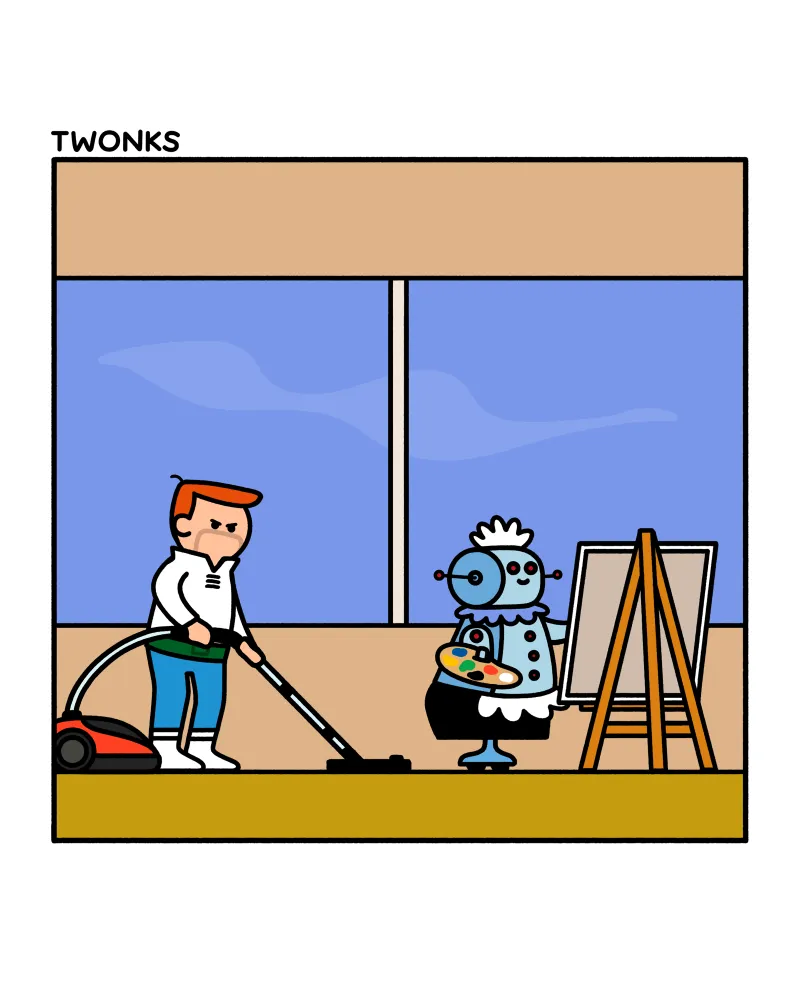
I can now put a series of commands into a computer screen and get a book length work of fiction as a result. I think of these things–our digital assistants, our LLM’s, our AI tools—as robots. And I do not like them. 

Oh, I am as guilty as anyone to ask Alexa what the weather report is, or to get Gemini to transcribe a lengthy handwritten note to computer editable text. But I refuse to use any of them for creative tasks. I have no desire to be replaced by a machine, or to outsource my creativity to it. I want to outsource the laundry, not the art and creativity in my life. 

An LLM can’t write a better story than I can, and even if it could, it still wouldn’t be my story, based on my experiences, having come from my thoughts. All it can do is write faster than I can. And whatever is wrong with my writing, it won’t get improved by increasing the speed. 

I know this is an unpopular position. Many of my readers work in the IT industry, and are already gearing up to tell me how I just don’t understand the tech. 

I have no interest in understanding the tech. I just want to tell stories, connect with people, and help them get through whatever thing they are struggling with right now. I am, at the end of the day, a Christian humanist. People over machines, every single time. 

People matter. So does art. And so do you. 

Asking the right question

This is the introductory essay from this week’s issue of my weekly newsletter, Life Is So Beautiful. The entire newsletter, including links to five things I thought were beautiful, can be found here.

I  turned 54 on the 5th of June. I know, I find it hard to believe myself. In my head I’m still 18, but a few months ago, I got a leg cramp while eating a taco.  

But Friday was a beautiful day, and the orange ditch lilies were in bloom at the bottom of our driveway, and I had been invited to do a reading from Food Is Love on Saturday at the Jimmie Roger’s museum in Meridian, MS for The Mississippi June Bugs Literary & Musical Society. Yes, that’s their real name! So, I took Friday off and we went to Meridian a day early. 

We went to the oldest restaurant in MS for lunch, and then hit up used bookstores and thrift stores before checking into the Threefoot Hotel, which is the nicest place in Meridian, and probably in this part of Mississippi. Marble and brass everywhere, and large hotel room with big views, all courtesy of The June Bugs. It was lovely. Then, we went to the annual convening of The June Bugs for supper at The Maxx, which is Meridian’s art and entertainment center. 

On Saturday I did my first ever reading (which is not really true—I preach from a manuscript every Sunday, but reading from your book is different than that, somehow) and it was a blast. And when I had sold and signed all the books I had brought with me, we went to a local Mexican restaurant and ate our fill of enchiladas before the hour and a half drive home. 

It was a lovely 24 hours away, and as close to a vacation as we have taken in almost a year, since my losing that job last year that had health insurance attached to it. Since then it has been a series of gigs and contract positions, which has paid our bills, more or less, but which hasn’t left either the income or the bandwidth for vacation. 

But the time away was generative, and the joy of hanging out with my wife/friend and doing nothing very urgent and laughing and coming home with a stack of books is crucial to my mental health. 

Long ago, I had a mentor tell me, when I said I could not do something, that the best way to reframe that was to ask myself “How can I do it?” And so, on the way home, Renee and I talked about how we can get away more, even though we cannot afford long trips to the beach or jaunts to Europe. 

We can explore Mississippi, for example, where nothing is more than 3 hours away. A day trip to the coast to the south or the Appalachian foothills to the north would just cost us gas money if we didn’t stay overnight. If it was a flush week, throw in a night at the Hampton inn and we would even get breakfast as part of the deal. I like the idea of being a tourist in my own state. 

Right now, I know a lot of us are struggling. Not all of us can do the things we used to do. If that’s you, maybe try what we did: Instead of being angry you cannot do a thing, ask yourself how you can do it.  You might surprise yourself.